


08 July 2020 : Animal Research
Letrozole Rat Model Mimics Human Polycystic Ovarian Syndrome and Changes in Insulin Signal Pathways
Jinbang Xu1AEG*, Jingjing Dun1CDE, Juan Yang1DF, Junxin Zhang1BF, Qiuping Lin1B, Mingqing Huang2B, Feng Ji3B, Lishan Huang3B, Xiumi You1B, Ying Lin3ABEGDOI: 10.12659/MSM.923073
Med Sci Monit 2020; 26:e923073


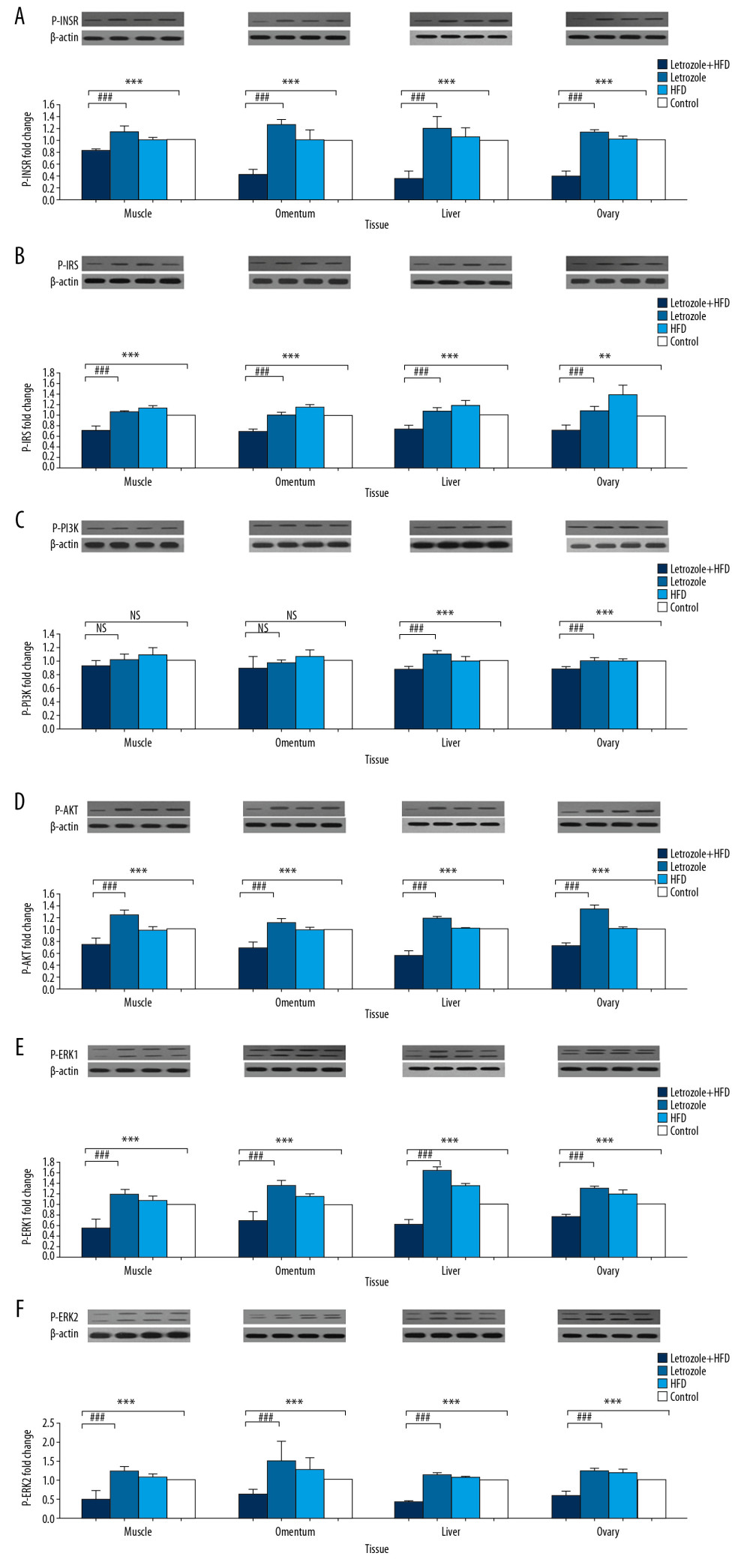
Figure 8 (A–F) The activity of insulin signaling in Letrozole+HFD, Letrozole, HFD, and control groups of rats. Protein contents in quadriceps femoris muscle (Muscle), omentum majus (Omentum), liver and ovary tissues were examined by Western blot with phospho-specific antibodies for insulin receptor (INSR, Y1361), insulin receptor substrate-1 (IRS-1, Y-612), phosphoinositide 3-kinase (PI3K, Y607), protein kinase B (AKT, Thr308), and extracellular signal-regulated kinases 1 and 2 (ERK1, Y204; ERK2, Y187). Band density was determined using ImageJ software (National Institutes of Health) and expressed as fold changes to each control group after normalization of each protein (band density) with its corresponding loading control (β-actin band density). Data are presented as mean±SEM of 6 rats and were analyzed by one-way ANOVA with Dunnett’s post hoc test. * P 0.05, ** P 0.01, *** P 0.001 compared with control group. NS – not significant.