


02 November 2020 : Clinical Research
Detecting Rare Variants and Heteroplasmy of Mitochondrial DNA from High-Throughput Sequencing in Patients with Coronary Artery Disease
Qian Jia12ABE, Lu Xu1CE, Juan Shen3CD, Yanping Wei3CD, Huaiqian Xu3B, Jinlong Shi24D, Zhilong Jia24D, Xiaojing Zhao12D, Chunlei Liu12D, Qin Zhong12F, Yaping Tian1AD, Kunlun He12A*DOI: 10.12659/MSM.925401
Med Sci Monit 2020; 26:e925401


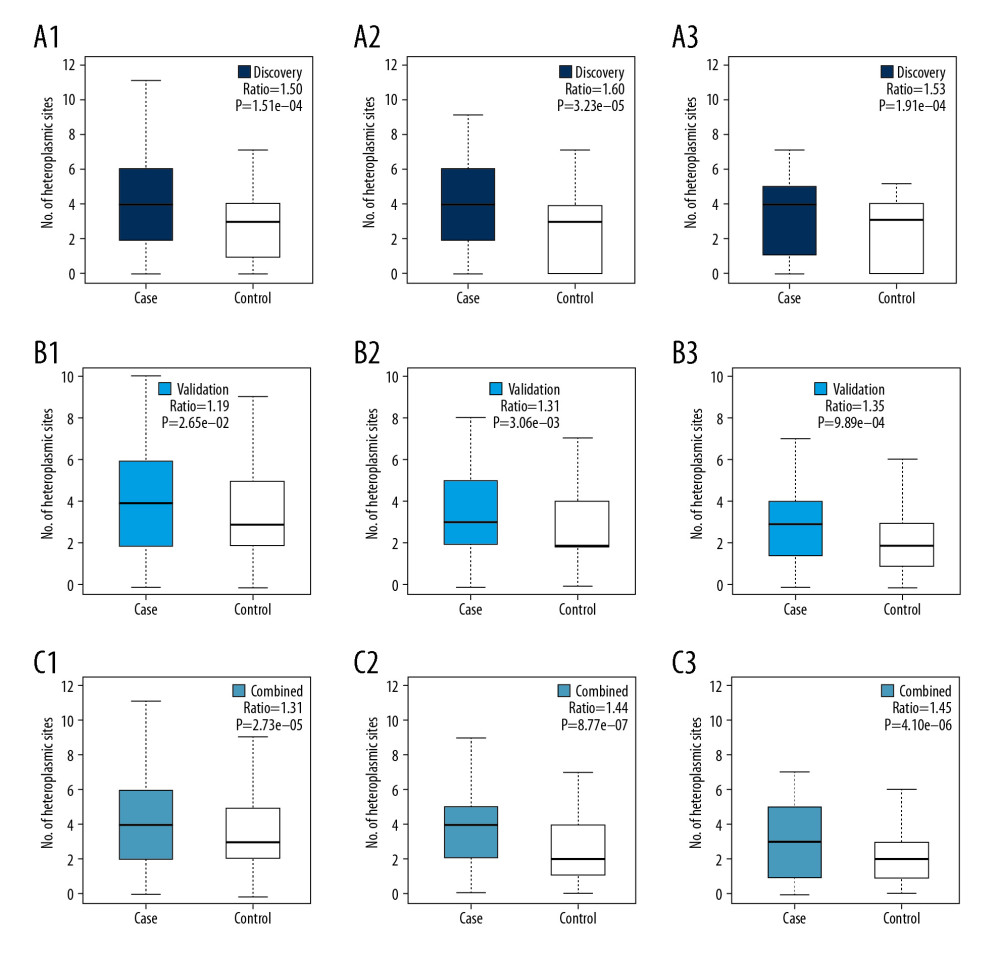
Figure 3 The non-synonymous heteroplasmy counts differed between cases and controls in both stages. We split heterogeneity sites into 3 groups according to the percentage of samples carrying one heterogeneity sites: the percentage >0% (A1, B1, C1), >2% (A2, B2, C2), and >5% (A3, B3, C3). For each group, the Wilcox statistic was used to test the heteroplasmy counts difference. The ratio was calculated as the mean count of heteroplasmic sites in cases divided by the mean -count of heteroplasmic sites in controls.