


03 March 2021 : Animal Research
A Network Pharmacology Study of the Molecular Mechanisms of Hypericum japonicum in the Treatment of Cholestatic Hepatitis with Validation in an Alpha-Naphthylisothiocyanate (ANIT) Hepatotoxicity Rat Model
Sen Ling Feng1ACE, Jing Zhang2BCEF, Hongliu Jin1BC, Wen Ting Zhu1BC, Zhongwen Yuan1ABCDEFG*DOI: 10.12659/MSM.928402
Med Sci Monit 2021; 27:e928402


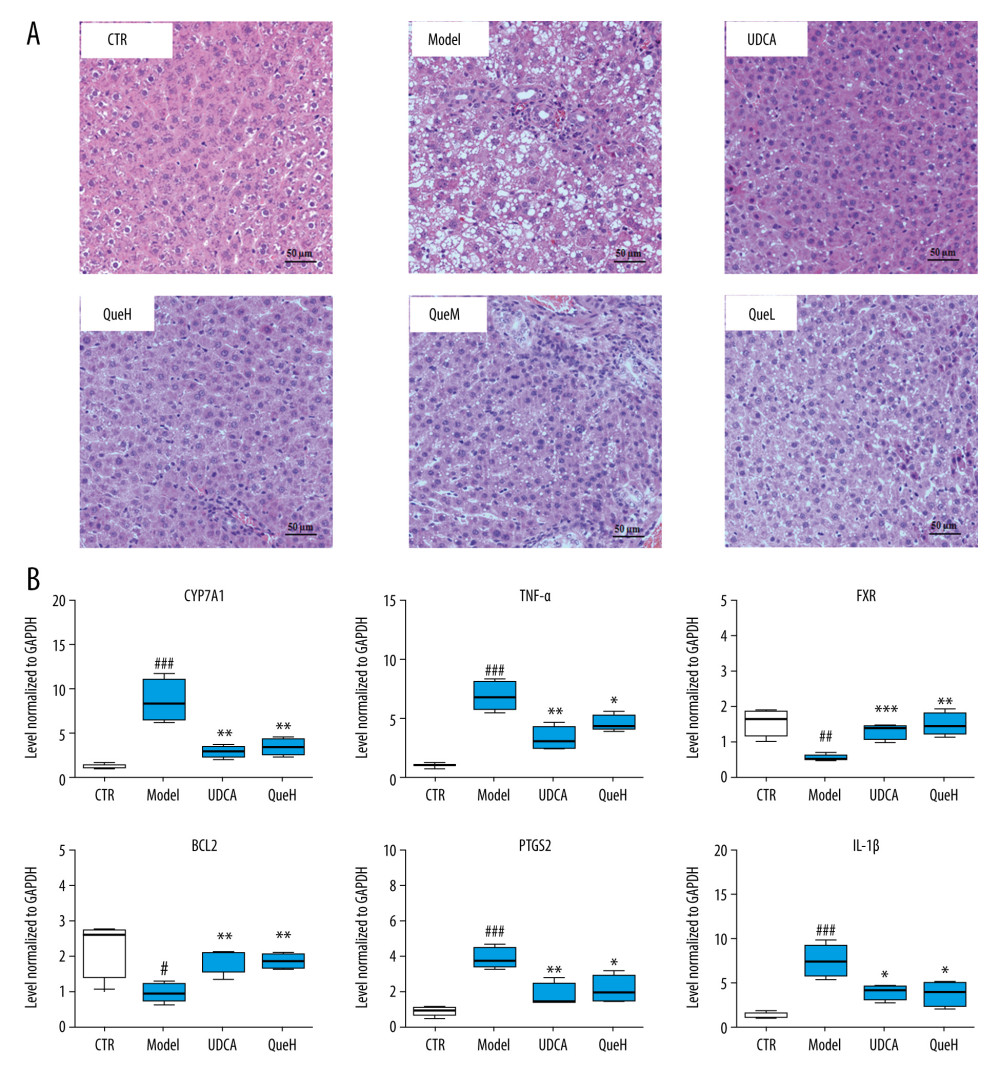
Figure 8 Pharmacological action and mechanisms of quercetin in alpha-naphthylisothiocyanate (ANIT)-administered rats. (A) Photomicrograph of the histology of the rat liver, control group shows normal liver histology. The liver histology of the untreated ANIT rat model group shows lipid vacuoles in the hepatocytes, mild inflammation, and cholestasis. The liver changes are reduced following treatment with ursodeoxycholic acid (UCDA) for 7 days; Group IV, high-dose quercetin (QueH) was treated with 200 mg/kg quercetin for 7 days; Group V, medium-dose quercetin (QueM) was treated with 100 mg/kg quercetin for 7 days; Group VI, low-dose quercetin (QueL) was treated with 50 mg/kg quercetin for 7 days. Hematoxylin and eosin (H&E) staining. Magnification ×40; (B) Restoration of PTGS2, BCL2, CYP7A1, FXR, IL-1β, and TNF-α mRNA expression in cholestatic hepatitis livers. # P<0.05, ## P<0.01, ### P<0.001 vs control group; * P<0.05, ** P<0.01, *** P<0.001 vs model group. Data represent mean±SD (n=6 for each group).