


28 January 2021 : Animal Research
Bluetongue Viruses Act as Novel Oncolytic Viruses to Effectively Inhibit Human Renal Cancer Cell Growth In Vitro and In Vivo
Haozhou Wang1ABCE, Liming Song1DEF, Xin Zhang1BCF, Xiaodong Zhang1AF, Xiaoguang Zhou1ABG*DOI: 10.12659/MSM.930634
Med Sci Monit 2021; 27:e930634


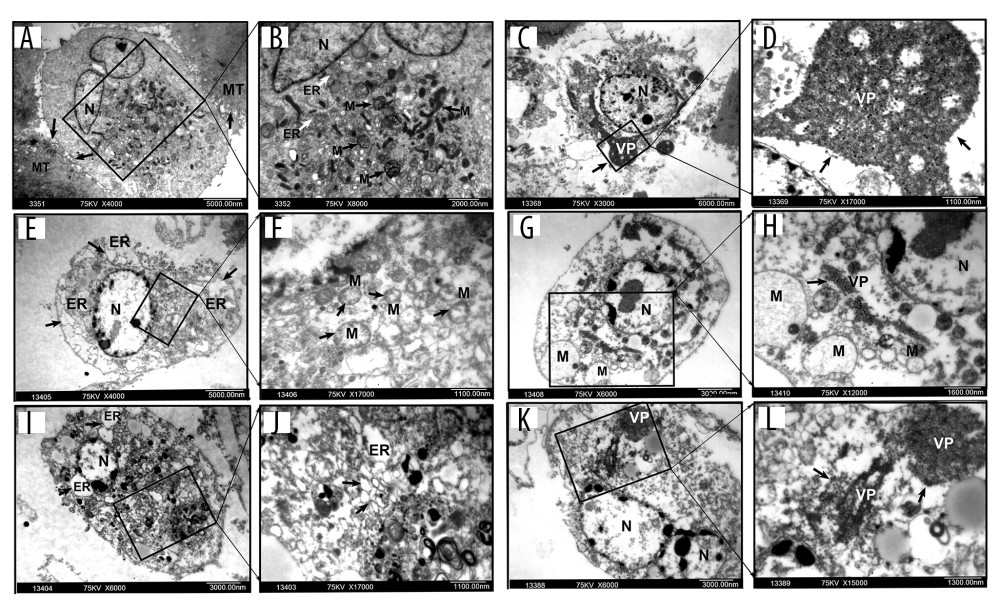
Figure 2 Electron microscopy of ultramicroscopic structure changes in 5 cell lines and HPTEC infected with BTV-10 72 hours after infection. HPTECs clearly show an unchanged ultramicroscopic structure compared to the untreated cells: microvilli (MT, arrows), chondriosome (M, arrows), rough endoplasmic reticulum (ER, arrows), nucleus (N) (A ×4000, B ×8000). Viral particles (VP) were observed in all the RCC cell lines, but not in the HPTECs (arrows) (B, C ×8000, D ×13000, G ×6000, H ×12000, K ×6000, L ×15000). Electron microscopy showed chromatin condensation along the periphery of the nucleus (C, E ×4000, G, I ×6000, K), expansion of the rough endoplasmic reticulum (arrows) (I, J ×17 000), decrease of mitochondrial matrix density, and balloon-like swelling (F ×17 000, G, H) in RCC cell lines. (A, B). HPTEC, (C, D). ACHN, (E, F). CAKI-1, (G, H). OR-SC-2, (I, J). 786-0, (K, L). A498.