


28 January 2021 : Animal Research
Bluetongue Viruses Act as Novel Oncolytic Viruses to Effectively Inhibit Human Renal Cancer Cell Growth In Vitro and In Vivo
Haozhou Wang1ABCE, Liming Song1DEF, Xin Zhang1BCF, Xiaodong Zhang1AF, Xiaoguang Zhou1ABG*DOI: 10.12659/MSM.930634
Med Sci Monit 2021; 27:e930634


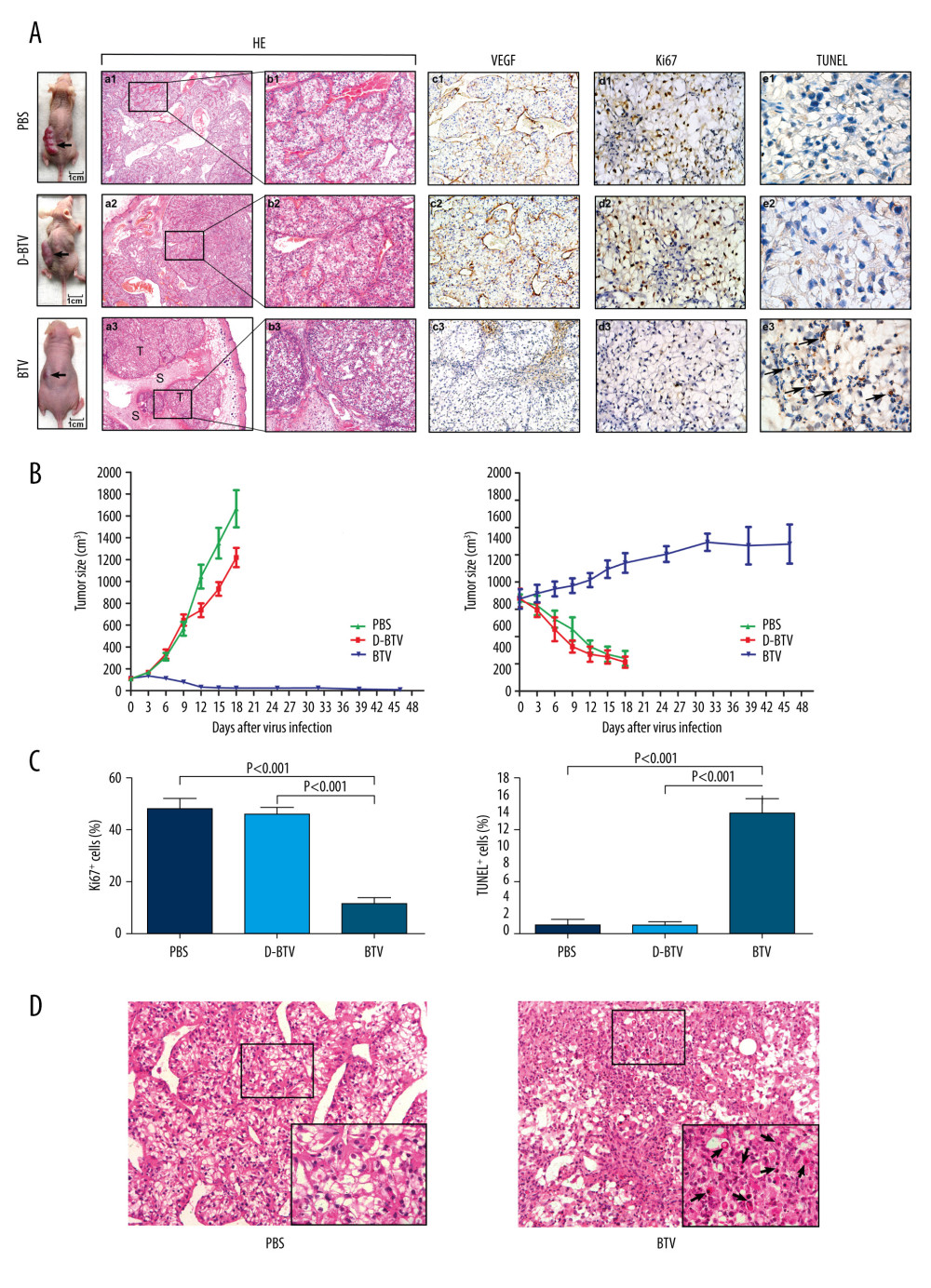
Figure 3 BTVs exert antitumor effects in a renal cancer OS-RC-2 xenograft mouse model. (A) Representative tumor sections from treated mice were harvested after treatment and analyzed by H&E (×40 and×100), cell proliferation (Ki67 ×400), apoptosis (TUNEL ×1000), or angiogenesis (VEGF ×200), by immunohistochemistry. The H&E staining shows that the tumor tissue had disintegrated into smaller components. T – tumor tissue, S – tumor stroma. Sinusoid-like blood vessels were occlusive, degenerated, or absent entirely. The VEGF staining showed less immunoreactivity in BTV-treated tumors than in control groups. (B) Tumor volume (mm3) was measured and the data are presented as mean±SD. Body weight was monitored continuously, and the data shown represent the mean±SD. (C) Quantification of mitotic index (left), and apoptosis (right). Labeled cells were counted in an average of 6 high-power fields. Data represent means±SEM. (D) H&E staining also revealed apoptotic-type cells, such as condensed nuclei and cytoplasm (arrow), in BTV-treated tumors.