


13 October 2021 : Clinical Research
Comparing the Traditional Versus Conservative Endodontic Access Cavities Design of the Maxillary First Molar: Using Cone-Beam Computed Tomography
Huachao Sui1ABE, Bo Zhao2ABE, Haidan Nie3BE, Xin Hao1BG, Feng Qiao4C, Cuicui Sun3C, Changyi Li5G, Liwen Zhou3E, Ligeng Wu3AG*DOI: 10.12659/MSM.932410
Med Sci Monit 2021; 27:e932410


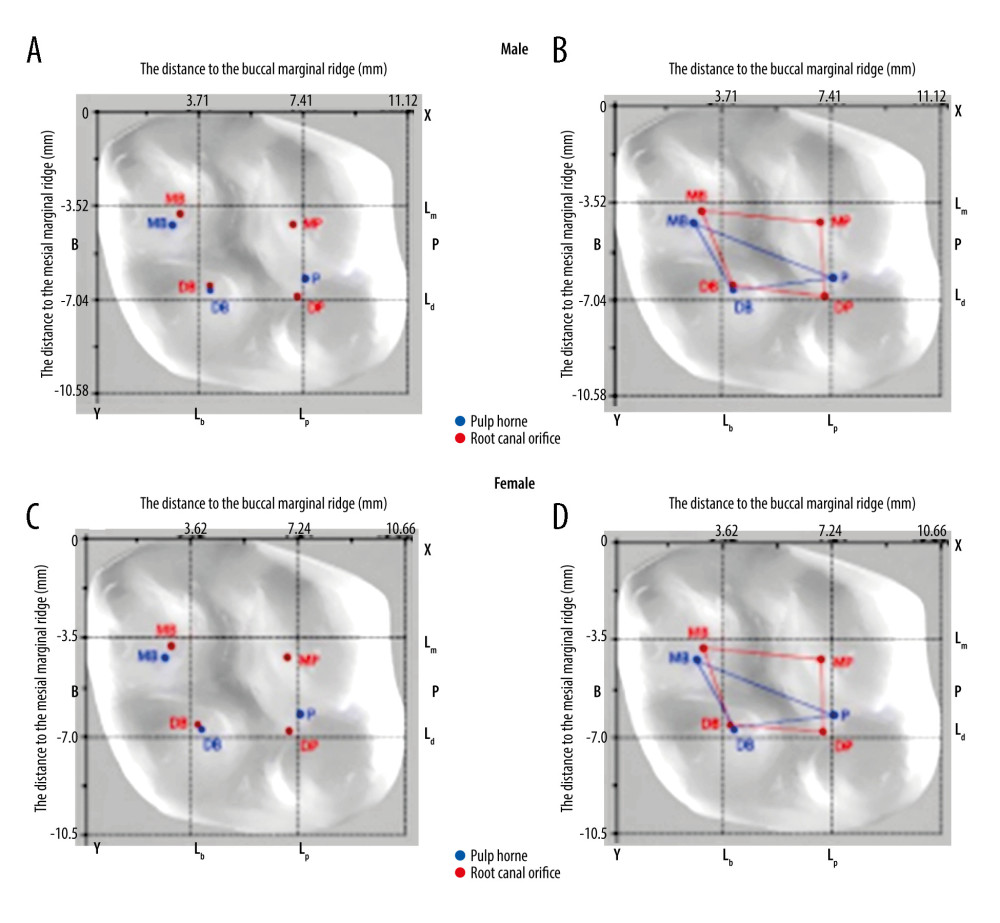
Figure 3 Schematic diagram of each anatomical landmark in the nine-rectangle-grid of males and females. (A) Distribution of pulp horns (red dot) and root canal orifices (blue dot) in the nine-rectangle-grid in males. (B) The blue triangle is the area formed by the root canal orifice projection-connecting lines the red oblique quadrilateral is the area formed by the pulp horn projection-connecting lines in males. (C) Distribution of pulp horns (red dot) and root canal orifices (blue dot) in the nine-rectangle-grid in females. (D) The blue triangle is the area formed by the root canal orifice projection-connecting lines. The red oblique quadrilateral is the area formed by the pulp horn projection-connecting lines in females. Lb – vertical dotted line near the buccal marginal ridge represents the trisection of the buccal-lingual diameter; Lp – vertical dotted line near the palatal marginal ridge represents the trisection of the buccal-lingual diameter; Lm – horizontal dotted line near the mesial marginal ridge represents the trisection of the mesial-distal diameter; Ld – horizontal dotted line near the distal marginal ridge represents the trisection of the mesial-distal diameter; MB – mesiobuccal; DB – distobuccal; MP – mesiopalatal; DP – distopalatal; P – palatal; TEC – traditional endodontic cavity; CEC – contracted endodontic cavity.