


18 March 2022 : Clinical Research
Unveiling the Differences in Biological Properties of Dental Pulp Stem Cells from Normal and Inflamed Pulp: A Comprehensive Comparative Study
Shao-Chen Nie12ABCDEF, Kun Yang3ABCD, Na-Na Luan12F, Xiao-Li Lian2B, Xiao-Hua Dai2C, Su-Xia Liang12A*, Ying-Bin Yan24ADOI: 10.12659/MSM.934511
Med Sci Monit 2022; 28:e934511


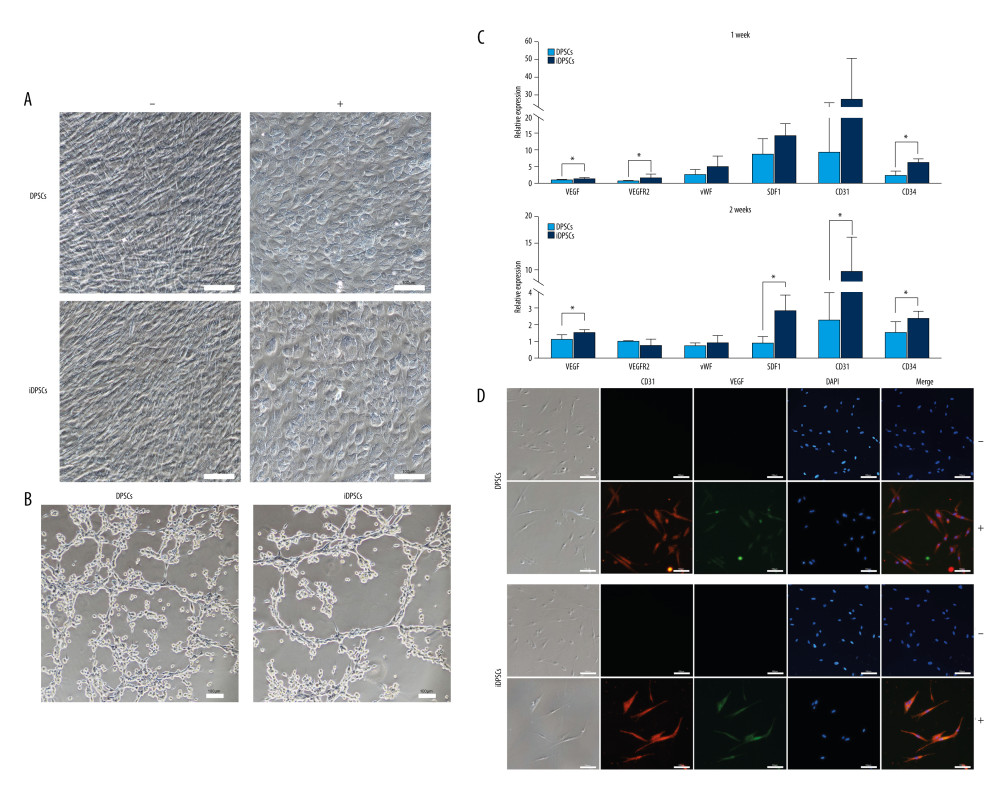
Figure 7 Angiogenic differentiation induction analysis. The cells were cultured in non-differentiated control medium (−) and angiogenic differentiation medium (+) for 2 weeks. (A) The cells showed a flat, paving-stone like shape after 14-day angiogenic induction (magnification, ×20; scale, 100 μm). (B) DPSCs and iDPSCs could form tubular network-like structure by Matrigel angiogenesis assay (magnification, ×20; scale, 100 μm). (C) several angiogenic lineage-specific genes were detected by real-time PCR. mRNA levels were tested in 5 independent samples. * P<0.05. (D) Expression of CD31 and VEGF in DPSCs and iDPSCs by immunofluorescence staining. All nuclei were stained with DAPI (blue). The cells were stained with antibody to VEGF (green), and CD31 (red). It was confirmed that DPSCs and iDPSCs co-expressed VEGF and CD31. magnification, ×20; scale bar, 100 μm. DPSCs – dental pulp stem cells; iDPSCs – inflammatory dental pulp stem cells; DAPI – 4′,6-diamidino-2-phenylindole. (Figure were created using Adobe Photoshop CS3, Adobe Systems Software Ireland, Ltd.).