


12 January 2021 : Clinical Research
Limb-Salvage Outcomes of Arterial Repair Beyond Time Limit at Different Lower-Extremity Injury Sites
Li Yu1ABCDEF, Linglong Deng1ABCDEF, Shaobo Zhu1BCD, Kai Deng1BCD, Guorong Yu1BCD, Chunquan Zhu1BCD, Baiwen Qi1ABCDEF, Zhenyu Pan1ABCDEF*DOI: 10.12659/MSM.927652
Med Sci Monit 2021; 27:e927652


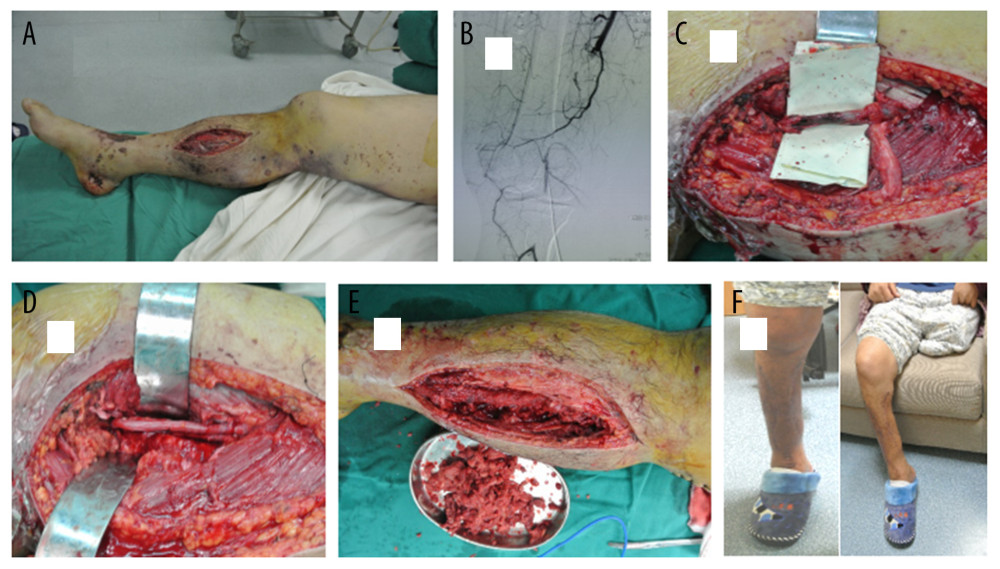
Figure 4 A typical example of delayed repair of SFAI (72 h). A 41-year-old man was struck by a car. In a local hospital, a closed dislocation of his right knee joint was reduced 8 h after the injury and an amputation was performed in his left leg due to the severity of the injury. Three days later, the patient was transferred to our hospital to treat the limb ischemia. A few mottling and some muscle-necrosis wounds were found on his foot (A). The angiography demonstrated injury to the superficial femoral artery, but the lateral branches of the deep femoral artery and the anterior and posterior tibial arteries were clearly presented (B). Intraoperatively, SFAI with long-segment embolus (C) was revascularized by SVG (D). After multiple debridements to remove necrotic tissue (E), the incision of the decompression of compartment was sutured. Lower extremity follow-up at 32 months showed good ankle and knee functions (F).