


12 January 2021 : Clinical Research
Limb-Salvage Outcomes of Arterial Repair Beyond Time Limit at Different Lower-Extremity Injury Sites
Li Yu1ABCDEF, Linglong Deng1ABCDEF, Shaobo Zhu1BCD, Kai Deng1BCD, Guorong Yu1BCD, Chunquan Zhu1BCD, Baiwen Qi1ABCDEF, Zhenyu Pan1ABCDEF*DOI: 10.12659/MSM.927652
Med Sci Monit 2021; 27:e927652


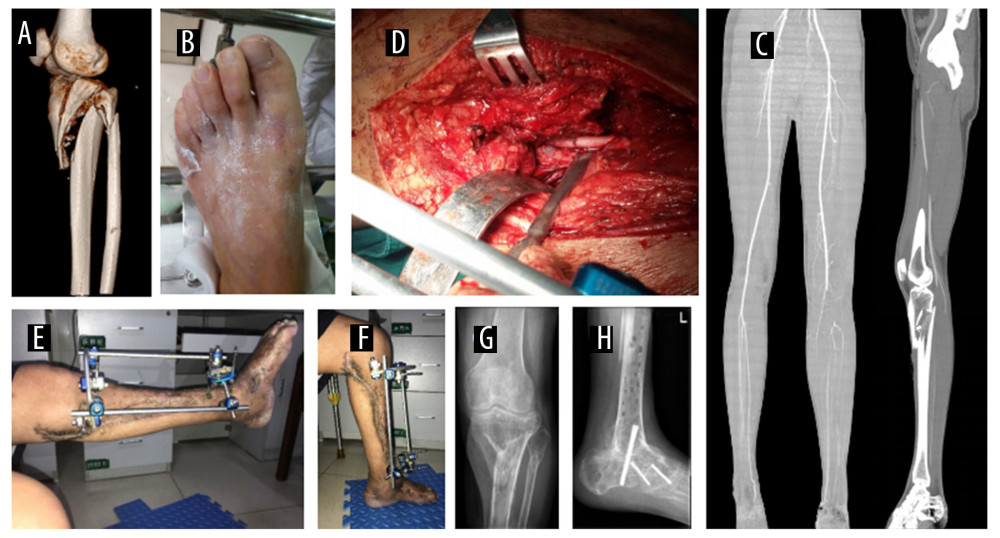
Figure 5 A typical example of delayed repair of PAI at DGMV (60 h). A 41-year-old man was admitted to a local hospital due to a traffic accident, suffering tibia and fibula fractures with a popliteal artery injury of his left leg (A). At 2 days after trauma, the patient was transferred to our hospital. The skin color of the left foot seemed normal but there was no pulse (B). CTA revealed popliteal artery embolization at DGMV, but the blood signal of the gastrector artery, the calf artery, and the collateral circulation were very clear (C). The PAI was confirmed intra-operatively, and revascularization was performed by end-to-end anastomosis (D). After external fixation of the fracture, good knee function was presented (E, F). However, 1 year after fracture healing, poor ankle function (clubfoot deformity) was corrected by four-joint fusion (G, H).