


08 August 2022 : Clinical Research
Identification of Hepatic Dendritic Cells in Liver Biopsies Showing Steatosis in Patients with Metabolic Dysfunction-Associated Fatty Liver Disease (MAFLD) Associated with Obesity
Beatriz Barranco-Fragoso12ABC, Shreya C. Pal 34CDEFG, Luis E. Díaz-Orozco 34ABCDEF, Rita Dorantes-Heredia 5BCD, Xingshun Qi6F, Nahum Méndez-Sánchez 34ACDEF*
DOI: 10.12659/MSM.937528
Med Sci Monit 2022; 28:e937528


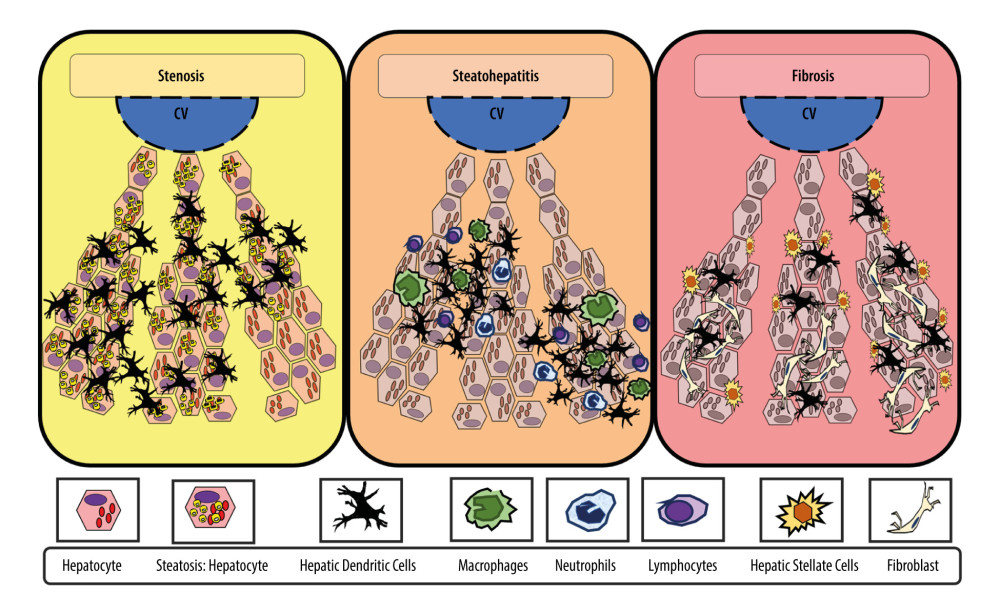
Figure 1 Adaptive changes of hepatic dendritic cells (CD11c+, hDCs) along the metabolic dysfunction-associated fatty liver disease (MAFLD) spectrum of diseasehDCs have an important role in capturing, processing, and presenting antigens. Initially, during MAFLD, when steatosis is stablished, hDCs tend to promote lipid hepatocytes storage with promotion of a tolerant and protective environment against fibro-inflammatory process. In contrast, during inflammation, the hDCs pool changes (eg, reduced lymphocytoid and plasmacytoid cells), with further expansion of matured hDCs and other innate immune cells (eg, neutrophils, macrophages) that promote and maintain fibro-inflammatory liver damage in advanced disease. In inflammation, fibrosis, and severe obesity, hDCs (CD11c+) appeared to be reduced or focally expressed, thus representing the tolerogenic and protective phenotype. Finally, during fibrosis, the hDCs (CD11c+) increased cytokine production induced a proinflammatory environment and proliferative responses of hepatic stellate cells (HSCs). Thus, focal expression of hDCs may stimulate HSCs, while diffuse expression of hDCs (CD11c+) in early stages might be characteristic of protective and tolerogenic cells (CD11c+).