


04 July 2025: Clinical Research
Comparative Analysis of Afamin, Asprosin, and Pentraxin 3 Levels in Women with PCOS and Women with Unexplained Infertility
Mehmet Kursat Derici ABCDEF 1*, Engin Yıldırım ABCDEFG 2
DOI: 10.12659/MSM.947895
Med Sci Monit 2025; 31:e947895


Abstract
BACKGROUND: Infertility is defined as the absence of pregnancy despite unprotected, regular sexual intercourse of couples of reproductive age for at least 1 year. Infertility may be unexplained or linked to anovulation/polycystic ovary syndrome (PCOS). PCOS can involve the processes of inflammation, insulin resistance, and metabolic syndrome. This study compared serum levels of afamin, asprosin, and pentraxin3 (PTX3) between women with PCOS and women with unexplained infertility to elucidate underlying pathophysiological mechanisms.
MATERIAL AND METHODS: Our study included 106 women: 55 with unexplained infertility and 51 with PCOS. Using the electrochemiluminescence immunoassay method, we assessed the levels of estradiol, follicle-stimulating hormone, luteinizing hormone, and anti-Mullerian hormone. Afamin, asprosin, and PTX3 levels were measured by ELISA.
RESULTS: Age, fasting glucose levels, and body mass index (BMI) of the groups were statistically similar. Anti-Mullerian hormone, antral follicle count, and LH levels were higher (P<0.05) in the PCOS group. Afamin and PTX3 levels were higher in the PCOS group (P<0.05), while asprosin levels were similar.
CONCLUSIONS: Our study demonstrates the importance of afamin associated with oxidative stress and the PTX3, which plays a role in the regulation of humoral immune responses, in the etiology of infertility cases. Afamin and PTX3 should be evaluated in ovulatory and non-ovulatory PCOS cycles to facilitate treatment and to elucidate the ovulation and implantation processes in PCOS. These recommendations specifically include dividing PCOS patients into subgroups such as diabetogenic, obese, and hirsute, and re-examining biochemical markers accordingly.
Keywords: Immunity, Humoral, Infertility, Female, Inflammation Mediators, Oxidative stress, Polycystic Ovary Syndrome, Humans, Female, Serum Amyloid P-Component, C-Reactive Protein, adult, Fibrillin-1, anti-müllerian hormone, Follicle Stimulating Hormone, Luteinizing Hormone, Body Mass Index, adipokines
Introduction
Infertility is defined as the absence of pregnancy in a couple of reproductive age despite regular sexual intercourse for at least 1 year without using any contraceptive method [1]. Infertility in one-third of infertile couples were found to be due to the female alone, and one-fifth were found to be due to the male alone. In addition, fertility problems were observed in 39% of both men and women. Ovulation disorder (32%) and tubal damage (26%) were identified as the most common causes of female infertility. The unexplained infertility rate is approximately 9% [2]. Anovulation is a common problem encountered, with various symptoms such as amenorrhea, menstrual irregularity, hirsutism, and infertility [3]. Polycystic ovary syndrome (PCOS) components can be listed as clinical and biochemical findings of hyperandrogenism, oligo-ovulation or anovulation, and polycystic ovaries seen by ultrasonography or direct inspection. About 60% of PCOS patients are fertile. The etiology of PCOS in patients with infertility needs to be clarified. Sometimes ovulation disorders, sometimes fertilization, and sometimes implantation failures cause these patients to be infertile. It has been shown that women with polycystic ovary syndrome can develop ovarian inflammation and fibrosis. In the same patient group, T cells showing anti-inflammatory function decrease and antibody levels increase in peripheral blood [4,5]. Pentraxin-3 (PTX 3) is a natural immune molecule that creates a humoral response, can bind to different types of ligands, specifically neutralizes some pathogens, and contributes to immunity that comes with birth [6]. PTX 3 is secreted in granulosa cells of preovulatory follicles, and its secretion increases with LH or HCG triggers. However, in a clinical study, PTX 3 plasma level was shown to decrease in PCOS patients in contrast to C reactive protein level [7]. A different clinical study showed that PTX 3 levels in follicle fluid are high in PCOS patients [8]. Since inflammation is known to be effective in ovulatory functions and fluctuations are known to occur in different periods of the female cycle, inconsistencies were observed between the measurements of PTX 3 levels in the 2 studies. Therefore, the primary aim of our study was to standardize PTX 3 plasma measurement according to the day of dominant follicle development and to clarify the role of inflammation especially in patients with polycystic ovary syndrome.
Insulin resistance and obesity are known to be involved in the etiology of anovulation and PCOS. As described above, there are accumulating data on the role of inflammation in PCOS [9]. Afamin acts as a vitamin E-binding protein and influences oxidative stress-related anti-apoptotic cellular processes [10]. It has been shown that the afamin molecule is present in follicular fluid and is not affected by the day of the ovulation cycle [11,12].
Afamin levels have been shown to increase as an inflammation marker in PCOS patients, but no data have been obtained about its change with ovulation [13]. With this study, we assessed the effect of afamin levels on ovulatory functions in patients with PCOS and to determine the changes in levels with ovulation.
Asprosin is a newly-discovered peptide hormone secreted from adipose tissue. Asprosin has been shown to have orexigenic activity by increasing glucose secretion from the liver by activating the G protein-cAMP-protein kinase A pathway [14]. It was found that asprosin levels were high in patients with type 2 diabetes and this increase was correlated with insulin resistance [15]. Asprosin levels were compared with healthy control groups because PCOS has metabolic syndrome components. Asprosin levels were found to be high in PCOS groups and were correlated with insulin resistance, BMI, and androgen index [16]. However, its levels before and after ovulation and its effects on fertility are still not clearly understood, and the pre- and post-ovulatory levels and their effects on fertility are also unclear. Our study will be a step towards understanding these effects and planning further studies. Therefore, our study aimed to reveal the role of asprosin levels in ovulation and anovulation cycles.
Material and Methods
We performed a study comparing 2 groups of patients: women with normal ovulation and women with ovulation disorders among couples with unexplained infertility. The study was conducted between 2021 and 2022 at the Department of Obstetrics, Faculty of Medicine, Turgut Özal University, Malatya, and the Faculty of Medicine, Department of Medical Pharmacology, Kırıkkale University. The Clinical Research Ethics Committee of Malatya Turgut Özal University (Approval No. /252021) formally endorsed the study, and all participating volunteers provided written consent. Volunteers were selected among female volunteers in infertile couples aged 18–40 years. Unexplained infertility is defined as the inability to achieve pregnancy without a cause despite 1 year of unprotected sexual intercourse [17]. The ovulation disorder group included women diagnosed with PCOS according to the Rotterdam criteria [18]. The study and control groups consisted of 50 patients each, and we obtained medical histories from all participants. Patients with endocrinologic diseases affecting reproductive functions, those receiving medical treatment that can cause ovulation disorder, smokers and other substance users, those under 18 years of age, and those over 40 years of age were not included in the study.
Ovulation functions and follicle development of the participants were monitored by sonogram in the infertility clinic. Ovulation induction was performed with clomiphene citrate 100 mg per day by perioral method. Antral follicle count and endometrial thickness were evaluated by sonogram in the early follicular phase. Estradiol was monitored on days 2–10 of the follicular phase. During this follow-up and treatment, medical examinations were performed, and approximately 5 ml of peripheral blood was separated, centrifuged, and stored in a freezer (−80°C) until the study day. The samples were also analyzed for estradiol (E2), follicle-stimulating hormone (FSH), and luteinizing hormone (LH), using electrochemiluminescence immunoassay (ECLIA) performed on an autoanalyzer (Cobas 6000, E 601 Roche Diagnostics, GmbH, Mannheim, Germany) every day. On the day of the study, afamin (RayBio® Human Afamin ELISA Kit ELH-AFM), asprosin (FineTest-EH4176;Wuhan-China), and PTX 3 (Invitrogen, Human PTX-3 ELISA Kit) levels were measured spectrophotometrically in biological samples by ELISA (BioTek Quant MQ200).
The demographic and biochemical data obtained were statistically analyzed with SPSS 22.0. Descriptive statistics are presented as mean±standard deviation and median (min–max) according to the data distribution; nominal variables are presented as number of cases and percentage. The distribution of the data was analyzed by the Shapiro-Wilk test. Data conforming to normal distribution were compared with
Results
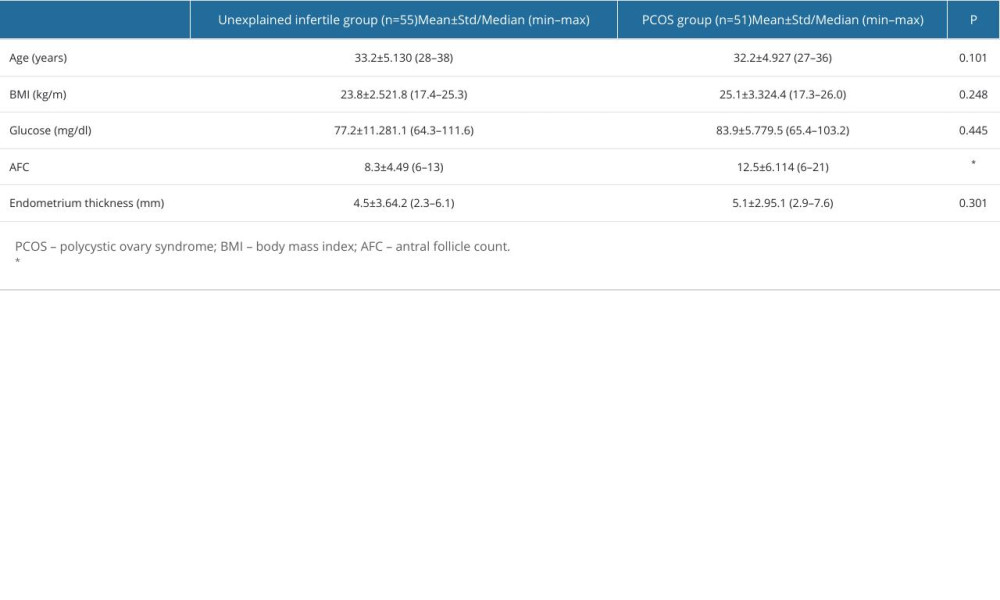
The study included 106 participants: 55 women with unexplained infertility constituted the control group, and 51 women with polycystic ovary syndrome constituted the study group. There was no significant difference the 2 groups regarding age, BMI, fasting blood glucose level, obstetric data, and endometrial thickness (
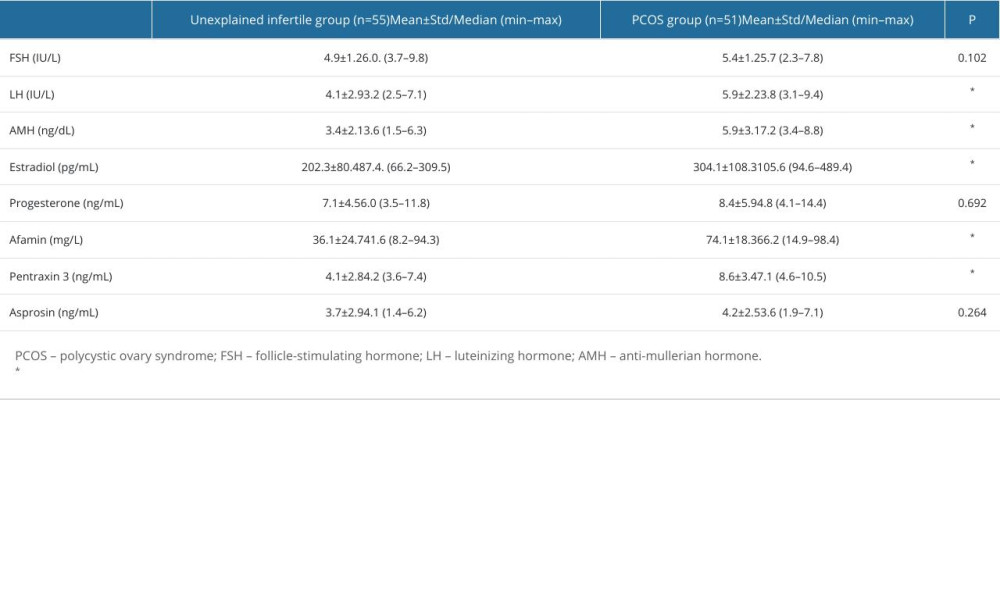
When the hormonal levels of the participants were evaluated, there was no significant difference between groups in FSH levels, while LH levels were higher in the PCOS group (
Discussion
Our study compared ovulatory infertile women and PCOS women with anovulatory cycles. The demographic data, fasting blood glucose levels, and obstetric data of the 2 groups were similar. However, AMH levels and estradiol levels were higher in the PCOS group. While Afamin and PTX 3 levels were significantly higher in the PCOS group, no significant difference was observed in asprosin levels.
We found higher levels of afamin in women with anovulatory cycles compared to ovulatory women. Oxidative stress is thought to be present in patients with polycystic ovary syndrome [19,20]. Afamin is the natural binding factor of vitamin E. A case-control study including 153 women found that afamin levels were lower in women with PCOS, similar to our study [21], differed from the present study in that we included women with fertility expectancy. Another study evaluated the association of afamin levels with metabolic syndrome in polycystic ovary syndrome patients and showed that it was correlated with serum triglycerides, BMI, and the Homeostatic Model Investigation (HOMA-I) [22]. In our patients, BMI and glucose levels were similar between the 2 groups, and this could not be assessed.
It has been shown that increased androgen levels and anovulatory cycles of patients with polycystic ovary syndrome may be associated with endothelial dysfunction and impaired cumulus oophorus expansion, and PTX 3 levels may be increased in these patients [8]. In addition, among PCOS patients, PTX 3 levels were higher in obese patients [23,24]. In our study, similar to the literature, PTX 3 levels were found to be higher in the PCOS group, while no relationship was observed between PTX 3 and obesity and insulin resistance.
Asprosin is a novel diabetogenic adipokine classified as a cardamines hormone protein. This adipokine is released from white adipose tissue during fasting and causes glucogenic and orexigenic effects. Plasma asprosin levels are associated with glucose metabolism, lipid profile, insulin resistance, and β-cell function [25,26]. In our study, when the PCOS group was compared with ovulable infertile women, no difference was observed in asprosin levels between the groups. In a study comparing PCOS patients with healthy volunteers, asprosin levels were higher than in our study, but the HOMA-I level was higher in the PCOS group, and this was correlated with increased Achilles tendon thickness [27]. Research suggests that a high asprosin level can affect metabolic syndrome, and is not necessarily associated with ovulation disorder [27]. Similar to our study, another study comparing ovulable women with women diagnosed with PCOS, no significant difference was found between serum asprosin levels, whereas levels of irisin, a muscle-derived brown adipose tissue differentiation factor, were found to be higher [28].
The main limitation of the present study is that no other agent was used as a third group in addition to clomiphene citrate. Therefore, it is not possible to explain whether the current findings are due to a pharmacokinetic effect or only to the induced oocytes.
Conclusion
Our study compared afamin, PTX 3, and asprosin levels between a polycystic ovary syndrome group and an ovulatory group in infertile women. As a result of this comparison, afamin and PTX 3 levels, which are molecules involved in the inflammatory process, were found to be high. Asprosin levels did not differ between the groups. Considering the relationship between metabolic syndrome and PCOS, our study showed that these molecules may be associated with follow-up or infertility in women with fertility expectancy. To determine the direct relationship of anovulatory cycles with these molecules, PCOS patient groups should be re-examined in women with similar PCOS demographic and metabolic data with and without ovulation after monthly ovulation follow-up.
References
1. Vayena E, Rowe P, Griffin P, Current practices and controversies in assisted reproduction Available from:https://iris.who.int/bitstream/handle/10665/42576/9241590300.pdf
2. Thonneau P, Marchand S, Tallec A, Incidence and main causes of infertility in a resident population of three French regions: Hum Reprod, 1991; 6; 811-16
3. Louwers YV, Laven JSE, Characteristics of polycystic ovary syndrome throughout life: Ther Adv Reprod Health, 2020; 14; 2633494120911038
4. Wang R, Mol BW, The Rotterdam criteria for polycystic ovary syndrome: Evidence-based criteria?: Hum Reprod, 2017; 32(2); 261-64
5. Subramaniam AG, Joseph A, Gupta A, Reduced Tregs in peripheral blood of PCOS patients – a consequence of aberrant Il2 signaling: J Clin Endocrinol Metab, 2015; 100(1); 282-92
6. Garlanda C, Hirsch E, Bozza S, Non-redundant role of the long pentraxin PTX3 in anti-fungal innate immune response: Nature, 2002; 420(6912); 182-86
7. Tosi F, Di Sarra D, Bonin C, Plasma levels of pentraxin-3, an inflammatory protein involved in fertility, are reduced in women with polycystic ovary syndrome: Eur J Endocrinol, 2014; 170(3); 401-9
8. Pan J, Zhou C, Zhou Z, Elevated ovarian pentraxin 3 in polycystic ovary syndrome: J Assist Reprod Genet, 2021; 38(5); 1231-37
9. Victor VM, Rocha M, Banuls C, Induction of oxidative stress and human leukocyte/endothelial cell interactions in polycystic ovary syndrome patients with insulin resistance: J Clin Endocrinol Metab, 2011; 96(10); 3115-22
10. Heiser M, Hutter-Paier B, Jerkovic L, Vitamin E binding protein afamin protects neuronal cells in vitro: J Neural Transm Suppl, 2002; 62; 337-45
11. Jerkovic L, Voegele AF, Chwatal S, Afamin is a novel human vitamin E-binding glycoprotein characterization and in vitro expression: J Proteome Res, 2005; 4; 889-99
12. Dieplinger B, Egger M, Gabriel C, Analytical characterization and clinical evaluation of an enzyme-linked immunosorbent assay for measurement of afamin in human plasma: Clin Chim Acta, 2013; 425; 236-41
13. Köninger A, Edimiris P, Koch L, Serum concentrations of afamin are elevated in patients with polycystic ovary syndrome: Endocr Connect, 2014; 3(3); 120-26
14. Romere C, Duerrschmid C, Bournat J, Asprosin, a fasting induced glucogenic protein hormone: Cell, 2016; 165; 566-79
15. Zhang L, Chen C, Zhou N, Circulating asprosin concentrations are increased in type 2 diabetes mellitus and independently associated with fasting glucose and triglyceride: Clin Chim Acta, 2017; 17; 30430-38
16. Alan M, Gurlek B, Yilmaz A, Asprosin: A novel peptide hormone related to insulin resistance in women with polycystic ovary syndrome: Gynecol Endocrinol, 2019; 35(3); 220-23
17. Romualdi D, Ata B, Bhattacharya S, Evidence-based guideline: Unexplained infertility: Hum Reprod, 2023; 38(10); 1881-90
18. Rotterdam ESHRE/ASRM-Sponsored PCOS consensus workshop group, Revised 2003 consensus on diagnostic criteria and long-term health risks related to polycystic ovary syndrome (PCOS): Hum Reprod, 2004; 19(1); 41-47
19. Diamanti-Kandarakis E, Piouka A, Livadas S, Anti-Müllerian hormone is associated with advanced glycosylated end products in lean women with polycystic ovary syndrome: Eur J Endocrinol, 2009; 160; 847-53
20. Yuan Y, He W, Fan X, Serum afamin levels in predicting gestational diabetes mellitus and preeclampsia: A systematic review and meta-analysis: Front Endocrinol (Lausanne), 2023; 14; 1157114
21. Voegele AF, Jerkovic L, Wellenzohn B, Characterization of the vitamin E-binding properties of human plasma afamin: Biochemistry, 2002; 41; 14532-38
22. Seeber B, Morandell E, Lunger F, Afamin serum concentrations are associated with insulin resistance and metabolic syndrome in polycystic ovary syndrome: Reprod Biol Endocrinol, 2014; 10(12); 88
23. Sahin FK, Sahin SB, Balik G, Does low pentraxin-3 levels associate with polycystic ovary syndrome and obesity?: Int J Clin Exp Med, 2014; 7(10); 3512-19
24. King N, Smart NA, Bungon T, Biomarkers in coronary artery disease: Systematic review and meta-analysis: Future Cardiol, 2025; 1; 39-46
25. Farrag M, Ait Eldjoudi D, González-Rodríguez M, Asprosin in health and disease, a new glucose sensor with central and peripheral metabolic effects: Front Endocrinol (Lausanne), 2023; 13; 1101091
26. Zeng X, Sun X, He W, Relationship of asprosin and diabetes: A meta-analysis: BMC Endocr Disord, 2025; 25(1); 15
27. Ozturk HA, Arici FN, Achilles tendon thickness and serum asprosin level significantly increases in patients with polycystic ovary syndrome: PeerJ, 2024; 12; e17905
28. Chang CL, Huang SY, Hsu YC, The serum level of irisin, but not asprosin, is abnormal in polycystic ovary syndrome patients: Sci Rep, 2019; 9(1); 6447
In Press
Clinical Research
Analysis of the Clinical Characteristics and Endoscopic Features of Phytobezoar-Induced Ulcers and Gastric ...Med Sci Monit In Press; DOI: 10.12659/MSM.952191
Clinical Research
Effect of Indirect Co-Culture With Gingival Mesenchymal Stem Cells on Cytokine Secretion in Primary Oral Sq...Med Sci Monit In Press; DOI: 10.12659/MSM.952439
Clinical Research
Comparison of Sleep Architecture in Individuals Aged 65 to 80 Years With and Without Mild Cognitive Impairm...Med Sci Monit In Press; DOI: 10.12659/MSM.952493
Clinical Research
Effects of Single-Bout Endurance Exercise Intensity on Peripheral Neurotrophic Factors in Patients With Isc...Med Sci Monit In Press; DOI: 10.12659/MSM.952089
Most Viewed Current Articles
17 Jan 2024 : Review article 14,176,514
Vaccination Guidelines for Pregnant Women: Addressing COVID-19 and the Omicron VariantDOI :10.12659/MSM.942799
Med Sci Monit 2024; 30:e942799
13 Nov 2021 : Clinical Research 3,760,677
Acceptance of COVID-19 Vaccination and Its Associated Factors Among Cancer Patients Attending the Oncology ...DOI :10.12659/MSM.932788
Med Sci Monit 2021; 27:e932788
14 Dec 2022 : Clinical Research 2,466,264
Prevalence and Variability of Allergen-Specific Immunoglobulin E in Patients with Elevated Tryptase LevelsDOI :10.12659/MSM.937990
Med Sci Monit 2022; 28:e937990
16 May 2023 : Clinical Research 708,906
Electrophysiological Testing for an Auditory Processing Disorder and Reading Performance in 54 School Stude...DOI :10.12659/MSM.940387
Med Sci Monit 2023; 29:e940387